

Many people look at dividends as a steady way to build wealth while still keeping ownership in the companies they invest in. Dividend investing appeals to beginners because it feels more tangible you can actually see cash payments arrive in your account. Dividend stocks pay regular income, but they also come with trade-offs that every investor should understand.

Online discussions often ask if dividend investing is worth it, especially on platforms like Reddit. Some argue that growth stocks offer better long term potential, while others prefer the consistency of dividend payouts. The real answer depends on personal goals, tax considerations, and risk tolerance.
A clear dividend investing strategy can help balance income with growth. Choosing between dividend stocks, growth stocks, or even dividend ETFs requires looking at advantages and disadvantages side by side. Dividend income can be taxed, so knowing how it fits into an overall plan is just as important as choosing the right stocks.
Dividend Investing Fundamentals

Dividend investing focuses on buying stocks that regularly distribute a portion of company profits to shareholders. It provides a way for investors to generate income while still holding ownership in the business. This approach requires understanding how dividends work, how to build a strategy, and weighing the benefits against the drawbacks.
What Are Dividends and How Do They Work?
Dividends are payments a company makes to its shareholders, usually in cash but sometimes in additional stock. These payments come from company profits and are typically distributed on a quarterly basis. Not all companies pay dividends, as many growth-focused businesses reinvest earnings instead.
Investors who hold dividend paying stocks receive payments based on the number of shares they own. For example, if a stock pays $1 per share annually and an investor owns 100 shares, they receive $100 in dividends each year.
Companies that pay dividends often have stable earnings and established business models. These firms use dividends to reward shareholders and attract long term investors. However, dividend amounts are not guaranteed and can be reduced or suspended if profits decline.
Dividend Investing for Beginners
Beginners often start dividend investing by focusing on well known companies with consistent payment histories. Large firms in sectors like utilities, consumer goods, and healthcare are common starting points because they tend to offer reliable dividends.
A key concept is the dividend yield, calculated as the annual dividend per share divided by the stock price. This helps investors compare income potential across different stocks. A higher yield may look appealing, but it can also indicate financial risk if the company’s payout is unsustainable.
New investors should also understand the payout ratio, which measures the percentage of earnings paid as dividends. A payout ratio above 80% may suggest limited room for dividend growth. Beginners often benefit from diversifying across several dividend-paying companies rather than relying on a single stock.
Dividend Investing Strategy
A dividend investing strategy can focus on either high yield stocks for immediate income or dividend growth stocks for increasing payments over time. Some investors combine both approaches to balance income and long-term growth.
Reinvesting dividends through a Dividend Reinvestment Plan (DRIP) allows investors to automatically purchase additional shares. This can compound returns over time without requiring extra capital.
Many investors also use dividend-focused exchange traded funds (ETFs) to gain exposure to a diversified set of dividend paying companies. ETFs reduce the risk of relying on a single stock and provide easier portfolio management.
Advantages and Disadvantages of Dividend Stocks
Advantages:
- Provide regular income without selling shares
- Can offer stability during market volatility
- Potential for long term growth if dividends increase
Disadvantages:
- Dividend payments are taxable in most cases
- Companies can cut or suspend dividends during downturns
- High dividend yields may signal financial weakness
Dividend stocks appeal to investors seeking income and stability, but they require careful evaluation. Balancing dividend yield, payout ratio, and company fundamentals helps reduce risks while maintaining steady returns.
Comparing Dividend and Growth Investing
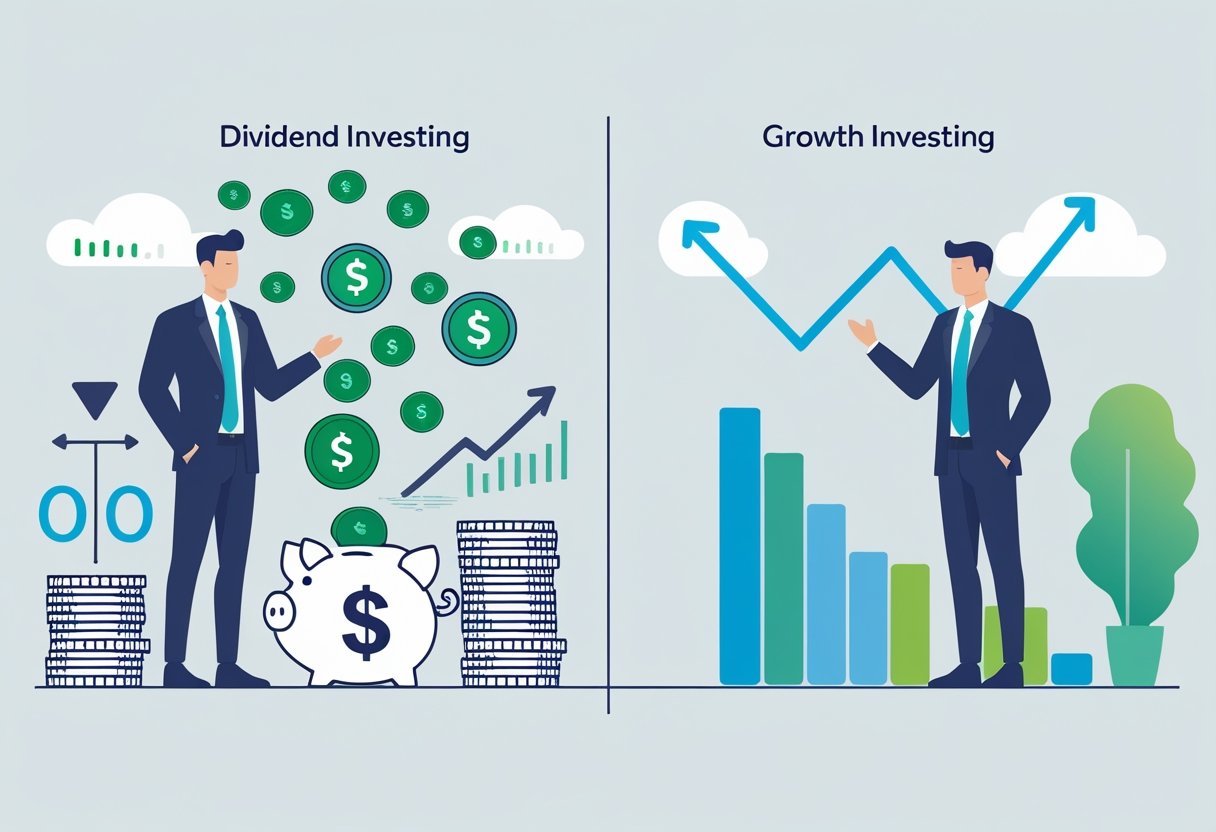
Dividend and growth investing follow different approaches to building wealth. Dividend stocks focus on income through regular payouts, while growth stocks aim for capital appreciation. Each method comes with distinct benefits, risks, and tax considerations that affect long term outcomes.
Is It Better to Invest in Dividend Stocks or Growth Stocks?
Dividend stocks provide regular cash flow, which appeals to investors seeking stability and income. These companies are often established businesses with consistent profits. The trade off is that dividend stocks usually grow at a slower pace than growth oriented companies.
Growth stocks reinvest earnings to expand operations instead of paying dividends. Investors rely on share price appreciation for returns. While growth investments can deliver higher gains, they also come with greater volatility and no guaranteed income.
A simple comparison:
| Feature | Dividend Stocks | Growth Stocks |
|---|---|---|
| Primary Return | Cash dividends | Price appreciation |
| Risk Level | Moderate to lower | Higher |
| Best For | Income focused investors | Long term capital growth |
| Volatility | Typically lower | Typically higher |
The decision depends on whether an investor values steady income or potential for larger long term growth. Many investors combine both to balance risk and reward.
Why Invest in Dividend ETFs?
Dividend ETFs pool money into a basket of dividend-paying stocks. This structure provides diversification, reducing the impact of poor performance from a single company. Investors gain exposure to multiple sectors while still receiving dividend income.
ETFs also simplify management. Instead of picking individual stocks, investors buy one fund that automatically adjusts holdings. This saves time and reduces the risk of relying too heavily on one company’s dividend policy.
Costs are another factor. Dividend ETFs typically have lower fees compared to actively managed funds. Many also reinvest dividends automatically, compounding returns over time.
For investors who want consistent income but prefer a hands off approach, dividend ETFs offer a practical balance of diversification, convenience, and cost efficiency.
Are Dividend Stocks Taxed?
Dividend income is generally taxable, but the rate depends on whether dividends are classified as qualified or ordinary (non-qualified). Qualified dividends usually receive lower tax rates, while ordinary dividends are taxed as regular income.
In the United States, qualified dividends must come from U.S. corporations or certain foreign companies and meet holding period requirements. This distinction can significantly affect after tax returns.
Investors should also consider tax advantaged accounts like IRAs or 401(k)s. Holding dividend stocks in these accounts can defer or eliminate taxes on dividend income.
Understanding tax treatment helps investors avoid surprises and plan more effectively when comparing dividend strategies to growth focused investments.
Is Dividend Investing Worth It Reddit
On Reddit, discussions about dividend investing often highlight its reliability for generating passive income. Many users share personal experiences of building portfolios that provide steady cash flow, especially for retirement planning.
Supporters argue that dividends offer tangible returns even when stock prices remain flat. They emphasize the psychological benefit of receiving regular payments, which can encourage long term holding.
Critics point out that focusing too heavily on dividends may limit exposure to higher growth opportunities. Some users argue that reinvesting in growth stocks can lead to larger portfolios over time, even without dividend payouts.
The general sentiment is mixed. Dividend investing is seen as valuable for income stability, but many Reddit users recommend combining it with growth strategies for balanced results.